Showing posts with label books. Show all posts

Tuesday, 19 July 2011

Literary Cleanup, book #14


Terry Pratchett - Mort (the portuguese translation is available at your local library)

The palate cleanser. After I read the previous two books, I started Dirk Gently's Holistic Detective Agency. I want to like Douglas Adams. I know he's funny, the ideas are interesting but the style of writing on that particular book is very hard to get into. 65 pages in, and no sign of wanting to continue, I figured I'd motivate myself by reading the last Discworld book on my shelf (for now, because much like Pokemon, I feel like I gotta catch 'em all).

I went through it about a week, which is quite fast for me, seeing as I only picked it up every other day. As with previous Pratchett books, I quite enjoyed this. More so because this book starts the Death saga (if you are unsure what I meant by that, click on this). Death is, without a doubt, one of the funniest characters in the whole Discworld universe. The all caps talking, kitten loving skeletal figure is at the core of this novel though he's not its main character, as I first thought.

The main character is a fella called Mort. Characterized as a person who "thought too much" and was "made of knees", he was pushed by his father to become an apprentice. His mentor? Death. From here, we not only witness the delightful minutia of Death's work and routine, but also, Mort's evolution into a person made out of less knees. I won't dive the story too much, as I want you to enjoy it as much as I did, but I'll state that this is probably the easiest read I had this year. So much fun in 300 pages...what more could you ask. Well, possibly a curry.

Excerpt:

"I'm no demon, I'm a human!" he said, and stopped in shock as his words emerged in perfect Klatch.
"So you're a thief?" said the father. "A murderer? To creep in thus, are you a tax-gatherer?" His hand slipped under the table and came up holding a meat cleaver honed to paper thinness. His wife screamed and dropped the plate and clutched the youngest children to her.
Mort watched the blade weave through the air and gave in.
"I bring you greetings from the uttermost circles of hell.", he hazarded.

Thursday, 7 July 2011

Literary Cleanup, book #13

(Which was also on my list of books I had to read for a class shelf.)


Mário de Sá-Carneiro - A Confissão de Lúcio (available at your local library)

Liking Fernando Pessoa as much as I do, I don't know how I never stumbled across the idea to read Mário de Sá-Carneiro. I guess I just forgot he existed, perhaps due to how short of a career he had. I will tell you up front that you should read this. I won't say I'm not biased because this is indeed a subject I really like to delve in (that being the pain connected to coming out and accepting who you are). In fact, I have, if I recall correctly, at least two other books dealing with the same problems. One of them, I even bought on impulse as soon as I read the back cover synopsis.

It's not only because of that. As some of you may know, it's said Sá-Carneiro was gay and obviously must have had an incredibly difficult time dealing with it. Lúcio sounds like him. A guy who is in law school, decides to go to Paris, becomes entranced with the city's bubbling night life, meets several people of "the arts", as you might call them. That was Sá-Carneiro's life. He was disappointed with Coimbra, so he moved to Paris and instead of finishing college in Sorbonne he was intoxicated by the culture (modernism was blossoming, so the sudden clash with the avant-garde aesthetic created a whole new artist in him).

Lúcio starts out the book by stating that he is in prison for a crime he didn't commit. He didn't murder his best friend, Ricardo de Loureiro, but now, years later, he writes to us to confess his innocence. He doesn't expect us to believe him, but he feels he must. This is how his story begins. We see his journey, from Lisbon to Paris and back again, along with his interesting relationship with Ricardo and eventually, with his wife Marta. I won't exactly spoil the book for you, because it is something I advise all of you to pick up, but Sá-Carneiro manages to not only be riveting but also intimate. You feel you are in a room with these characters, watching things happen. There's also a sort of raw sensuality in his words, along with a deep pain. His way of describing certain situations is so palpable and interesting to discover that I think I may pick this up again to read it with a bit more time. After all, because I had to read this for a class, I was rushed, and I felt like I didn't pay it the attention it deserved.

Even still, Lúcio, Ricardo and Marta will remain in my mind for a long time. As will Mário de Sá-Carneiro.


Excerpt:

As bailadeiras começaram as suas danças. Tinham as pernas nuas. Volteavam, saltavam, reuniam-se num grupo, embaralhavam os seusmembros, mordiam-se nas bocas…
Os cabelos da primeira eram pretos, e a sua carne esplêndida de sol. As pernas, talhadas em aurora loura, esgueiravam-se-lhe em luz radiosa a nimbar-se, junto do sexo, numa carne mordorada que apetecia trincar. Mas o que as fazia mais excitantes era a saudade límpida que lembravam de um grande lago azul de água cristalina onde, uma noite de luar, elas se mergulhassem descalças e amorosas. A segunda bailadeira tinha o tipo característico da adolescente pervertida. Magra — porém de seios bem visíveis —, cabelos de um louro sujo, cara provocante, nariz arrebitado. As suas pernas despertavam desejos brutais de as morder, escalavradas de músculos, de durezas — masculinamente.

Thursday, 30 June 2011

Literary Cleanup, book #12*

*Because it totally counts as a "book on my shelf", even though I had to read it for a class I was taking this year. Well, college caught up with me and I pretty much lost my mind. Couple that with the fact that getting through Dirk Gently's Holistic Agency is proving to be incredibly difficult, and you have a span of almost a year between the last book I reviewed (I use that word loosely, of course) and this one.


Nome de Guerra - Almada Negreiros (avaliable at your local library)

Apart from Manifesto Anti-Dantas and some of his paintings, I knew very little about Almada Negreiros. In fact, I didn't even know how much of a pioneer he was. We can see his work throughout Portugal, be it sculptures, paintings, quotes or murals, he's kind of...everywhere, really. But that's a subject for another post. For my money (or no money, really, since I use libraries religiously, and I advise you all to do the same), is it worth it to read "Nome de Guerra"?

I'd say that it's worth it for what it is. I'll explain. It's Negreiros' only novel and it's a very important work for its time. Though it was published in 1938 it was written much, much earlier, in 1925. Which means that it actually coincided with the Presença magazine movement, which Negreiros was also a part of. I'd say it's a very relevant book in portuguese literature...but I didn't really like it.

It has a very fragmented structure, so you learn the story from short snippets that are not directly linked, sometimes. The main guy is called Luís Antunes and he's a small town, simple guy. You can see already where this is going, right? If your hunch was "goes to the city, gets amazed by the sights and the women", you are correct. He eventually meets a prostitute who calls herself Judite and starts a sort of journey where he discovers who he really is. The book doesn't end with him feeling bad about being "tainted" and wanting to go back to his simple country life. No, that's...the middle of the book. And then the realizes that he is a new man and that he will make his own life wherever he wants to. And that both Maria (his country bride) and Judite were the same: just steps to reach his final goal of fully knowing himself.

The book is also peppered with lots of monologues from the narrator in which he discusses peculiar aspects of life (such as why we have names in the first place), that serve as a parallel for the events Antunes goes through, but they can also be interpreted as his own introspection, albeit with a distant tone.

In itself, as I've mentioned, it's a very interesting piece, but it didn't captivate me. Perhaps it was because I had read similar-themed works that I quite enjoyed (A Queda Dum Anjo being one of them) or maybe it was just his style of writing, but really, it all boils down to the fact that I couldn't relate to anything. Well, except for the brothels.

Excerpt:

Por sorte, a vaca não tem apelidos de família para lhe complicarem a existência. Mas, como é animal doméstico, vem a dar-lhe na mesma que tenha ou que não tenha apelidos. O ser animal doméstico faz com que fique dentro da circunscrição dos apelidos da família em casa de quem serve. A vaca é «Pomba», «Estrela», «Aurora» ou «Vitória» como uma pessoa podia ser apenas José, Maria, Luís ou Judite. É a domesticidade que leva a estas designações e para evitar o opróbrio da fria enumeração. São feitos da gentileza com facilidades para distinguir. Mas a verdade é que o facto de alguém ser Joana ou Manuel já é mais do que ser apenas homem ou mulher. Ser homem ou mulher é apenas a natureza; chamar-se João ou Manuela já é a natureza mais a vida inteira: é o problema. E se o João é Sousa e a Manuela é Pereira, então, à natureza e à vida junte-se-lhes ainda por cima a existência e complicou-se o problema.

Wednesday, 21 July 2010

Literary Cleanup, book #11


Los Mares del Sur - Manuel Vázquez Montalbán (available at your local library)

It's always harder for me when I don't know the author, and even harder when, after reading the book, I am puzzled as to whether I liked it or not. Mares do Sul is a perfect example of that. Nothing wrong with the book...well, if I said there was nothing, I'd probably be lying. This is one of those which I can't say I disliked, but I do have a lot of issues with it.

Mares do Sul is - according to the man's Wikipedia - one of the first books in the Pepe Carvalho saga, if you can call it that. Most of Montalban's work was devoted to exploring the stories (and work, obviously) of this 50 year old guy. Now, he's not just any dude, he's probably the first protagonist of a crime novel that fails completely at gathering my sympathy.

He's sold to us as very charming, with his vast culture, love of fine cuisine and blunt manner of speaking. In my mind, however, he's simply grumpy, obsessed with everyone's political standing and devoid of any kind of moral. He treats the women he meets like utter shite. He supposedly has one girlfriend, but he does not hesitate to fuck the teenage daughter of one of his most important clients, regardless of her many issues. She's a heavy user of all kinds of drugs and due to the death of her father (which Pepe is investigating), starts showing her real insecurities and becomes enthralled with this old man who never lets his guard down.

He fucks her, makes fun of her cocaine use - when she waits at his house for him, she prepares dinner...the first words he says are something similar to "nice meal, but where's the coke?". Perhaps this is supposed to be funny. To me, he just sounds like a guy that has no problems in using people to get what he needs. Be that money, food (since his "helper" always cooks for him) or a quick lay.

Still on women: he thinks he's such a fucking irresistible piece of ass, even when he's being shut down in a grand manner (see the excerpt for a clear illustration of this) or even when he's losing his erection. Don't believe me?

"Carvalho saltou da cama, procurou na mesita-de-cabeceira a caixa de Condal número 6, acendeu o charuto, sentou-se na beira da cama e contemplou como de uma varanda o espectáculo do seu pénis em retirada lenta."

He stood in awe of his flaccid penis. He lit a cigar to celebrate the fantastic awesomeness of his limp dick. This bloke is so into himself that I do wonder why he bothers fucking other people. Perhaps he needs someone to hold the mirror. Or camera. Or to sell tickets to his flappy show.

Another "cool" thing he does? He burns books instead of wood in his fireplace. Now that's just stupid. I have no words to describe how pathetic an attempt at being suave (or something) that is. Plus, in most scenes, instead of dialogue or ANY action whatsoever, we're treated to endless streams of his memories which are never relevant to the story. They are the kind of thing that you hear from people when they have no other arguments; the "in my time, things went smoothly" line of thought. For him, and his immaculate past, all other human beings are wrong, silly and have no real purpose in life. He doesn't trust anyone, and yet people keep falling at his feet, presumably because they see him as enlightening.

Even when the story finally ends, we see a powerful, rich woman be insulted by him...and then, because he's CHARMING OR SOME SHIT she decides to ask him to come and be his boy toy. Despite the fact that he's probably older. And, according the descriptions, not very attractive.

The story itself is somewhat interesting, and would probably be more had the author not focused so much on the inner dwellings of Pepe Caravalho and actually tried to build other charaters that didn't worship him instantly. Plus, he did have a clever way of presenting the story to us, and it didn't seem like the clues fell on Pepe's feet. The pacing could have been much better if so much of the book wasn't 70% "oh, woe is me, I'm so awesome and everyone else is stupid and ugly". Seriously, do we need a monologue in the middle of each scene? I think not.


I guess this is a decent read, but the main guy is such an asshole, I'd have problems recommending this to anyone else. Maybe it's just me, being a girl, with my girly feelings. Or maybe he's a fucking asshole. Yeah, probably that.

Excerpt:

Carvalho tinha vontade de lhe dizer: tinha o poncho, meu amor, e vamos para uma cama negra, branca, redonda, quadrada, tanto faz, porque quando a burguesia não pode conservar o controlo da cama, começa adjectivá-la.

- Vais continuar aqui, ou vens beber seis garrafas de vinho branco absolutamente sensacional?
- És rápido, forasteiro. Que insinuas?
- Que vamos para a cama.
- Não há dúvida. Conheces Juanito Marsé. É a sua técnica. Diz que lhe deram muitas bofetadas, mas que também teve muita sorte.
- E eu? A bofetada?
- Não. Mas também não a sorte. Estou à espera da minha miúda. Tenho-a aparcada lá dentro. O nosso é um amor impossível.
- Tinha acabado de nascer.
- São os melhores.

Carvalho despediu-se com uma pequena vénia. Na rua concentrou-se no tema dos amores que acabam de nascer.

Monday, 5 July 2010

Literary Cleanup, book #10


Cartas a Sandra - Vergílio Ferreira (available at your local library)

To be very honest, I don't remember much about Aparição. It's been a while since I read it, so my memory is quite hazy. I do remember, however, feeling like I didn't get it, but I wanted to. That's why I picked up Manhã Submersa from my mum's shelf. I liked that one a lot, even though it was about something I can't possible relate to. Sometime after that, I recall my friend David telling me he loved "Cartas a Sandra" and that it was very sad, but wonderful. Later, someone let me borrow their copy of it and I had it sit on my shelf, unread, for almost 3 years. A few days ago I finally finished the book.
I'll be honest with you: I did try, I did force myself to read when it seemed like I just couldn't do it. I even started my next book just to refresh my will to finish Cartas a Sandra. I still cannot say I have fully read the book, as I skipped over some parts, because I just wanted it to end. Unlike Manhã Submersa, or even Aparição, the aim of this one escapes me and though I wanted to understand Paulo and Sandra's story, I think that perhaps I have should read Para Sempre first, as it probably helps to understand their relationship. That being said, I don't think I will. I have seen love letters like these often so for me, it was hard to immerse myself in their world. I don't think they sound fake, but I do find it hard to believe the feeling itself. I know this sounds confusing, but bare with me.
I get that Paulo loves her. It's a given. However...why does he? What motivates this love? What made it so strong? Feelings don't always need to be justified, but in a book as short as this perhaps we would have been better served with something more substantial to explain their chemistry. Maybe I need to read it again to find out, because I suspect the answer is in the book, but as I didn't find it, I am solely left with a feeling of puzzlement and distance towards the characters.

Will not say I don't recommend it, because I suspect it's just not my cup of tea, rather than a really horrible literary piece.

Excerpt:

Como poderia eu ter imaginação para te reconstituir na sólida delicadeza da tua fragilidade? Sandra. O amor e a morte inserem-se um no outro, deves saber. Mas eu sobrevivi e isso é uma condenação. Penso-te e o teu esplendor renasce-me no meu pensar e a minha idade retrai-se quando me apareces. E a eternidade em que se vive, mesmo se a velhice é real, restabelece-me igual a ti que nunca envelheceste. E não me perguntes porque te escrevo, se tudo é vão, Mas há o meu desejo de te fixar na palavra escrita que te diz, para ficares aí com o milagre que puder. É Primavera e tudo é nítido no seu ser real. Os campos cobrem-se de relva, as flores despertam da sua hibernação, passa na aragem o perfume da vida, de tudo o que é vivo no mundo. A luz nítida demora-se no cimo dos montes e eu olho-a na sua agonia para um pouco existir no que te digo. Ou no teu nome de que não gostavam muito e agora renasce em sonoridade branda quando o penso ou o escrevo ou o digo em voz alta.

Monday, 28 June 2010

Literary Cleanup, book #9


Daisy Miller - Henry James (free to read @ Project Gutenberg)

Another one bites the dust. Daisy Miller tells the story of the various encounters between Winterbourne, a classy american young man studying in Europe and the eponymous american girl who is...non-conventional to say the least. It's not the easiest of reads because the descriptions sometimes seem long-winded and almost pointless - how many times do you have to tell me that Daisy is the prettiest pretty that ever prettied? Also, I fail to see the charm in her, when, throughout the book, she just seems like an immature, volatile and hedonistic young lady. Sure, she's pretty, but every time someone characterized her as "innocent", I couldn't help by chuckle, because it seemed clear to me that her every word was calculated to provoke longing in the gentleman that surrounded her. Essentially, what I'm saying is...Daisy Miller is a cock-tease.
Note this, however: even though I didn't like her, and even though I think the only reason Winterbourne kept going to her despite being shut down every time was because he thought he could tame her and transform her into the perfect girl he imagined...I liked this. I liked the story, and I liked that the characters actually brought out a reaction in me, which speaks of James' style of writing, I think. Plus, much like Winterbourne, I was indeed intrigued by her real motives and how it would unfold in the end. If you like period pieces, then this is a good one to consider.

Excerpt:

Por um instante fez uma nova pausa; olhava para Winterbourne com toda a beleza dos seus olhos francos e alegres, o seu claro, se bem que um tanto uniforme, sorriso.

- Sempre tive muita vida social com cavalheiros - afirmou.

O pobre Winterbourne estava divertido e perplexo - acima de tudo estava encantado. Nunca ouvira uma única rapariga exprimir-se daquela maneira; ou, pelo menos, nunca senão nos casos em que dizer tais coisas correspondia a ter, ao mesmo tempo, uma assaz complicada consciência delas. E no entanto deveria ele acusar Miss Daisy Miller de um real ou potencial arrière-pensée, como se dizia em Genebra? Sentinu que tinha vivido durante tanto tempo em Genebra que acabara por ficar moralmente confuso; tinha perdido o sentido correcto do jovem tom americano.

Wednesday, 23 June 2010

Literary Cleanup, book #8


The Call of the Wild - Jack London (free to read/hear @ Project Gutenberg)

I knew nothing about Jack London prior to reading this book. I'm not sure if I now know anything about who he is now, because The Call of the Wild isn't your average short story. First off, you are reading from the perspective of a dog (Buck) and the time seems to flow much faster even though from the time you are introduced to Buck up to the end of the book, only 6 years have passed. Well, I'm not completely sure it's 6 years, but it's probably not much more than that. And again, it's a weird one because I'm not sure how to feel about it. For one, I kept flinching at every mention of animal cruelty - and there is a lot of it. Not gratuitous, I think - it's reasonable to assume that such things happened...and sadly, some of them still continue to happen today. Still, apart from that, there really wasn't time to connect with the characters and even if I consider that maybe this was intentional, to show how different animals are in different situations, I cannot say I really enjoyed this one. Not that it's bad, mind you, but to me, it's so forgettable I honestly cannot say I'm interesting in reading any other of Jack London's books. As usual, I may give him the benefit of doubt.


Excerpt:

Buck não lia os jornais, pelo que não sabia que iriam surgir problemas, não só para si próprio como para todos os cães de grande porte, com músculos poderosos e pêlo longo e quente, de Puget Sound a San Diego. E isso porque os homens, tacteando na escuridão árctica, tinham encontrado um metal amarelo e, tendo em vista o enorme valor atribuído à descoberta pelas companhias de navegação e transportes, precipitavam-se aos milhares para as terras do Norte. Esses homem queriam cães, cães possantes, com músculos fortes para a labuta e pêlo espesso que os protegesse do gelo.

Monday, 21 June 2010

Literary Cleanup, book #7


A Queda D'um Anjo - Camilo Castelo Branco (free to read @ Project Gutenberg)


Been wanting to finish this one for quite some time. I had tried to read it before, but I always got stuck in the first few chapters. Now I know it really isn't my fault because the book starts with a whole lot of establishing who the main character is, how he behaves, looks and feels about the world, and in particular, politics. A Queda D'um Anjo is the story of Calisto Elói, a simple man from the Minho region who comes to Lisbon because he's persuaded by his closest friends that he should be in the parliament, setting the example. I won't reveal too much, but I'll say this: the title explains it all. It's a very cutting novel, digging into the worst of our political class - and it is, unfortunately, not dated in the slightest. I read that this book is quite different from what we would expect of Castelo Branco, since he's mainly known for his novels. As the only other one I've read is Amor de Perdição, I can't judge, but I will recommend this, as it is a very easy and gripping read. Also, it has many funny moments, especially when Calisto is just settling in his Lisbon quarters. In one of them, for example, he was feeling a bit under the weather, so he decided to follow the advice of one of his "classics" and drink the reinvigorating water from a fountain in Lisbon. It just so happens that after drinking that water, he felt even worse, which made him look at the book again and see that the cure for an upset stomach (which was caused by the same, possibly polluted water he drank) was drinking some more of that water. That chapter ends with the narrator informing us that from then on, he only drank wine.
Also, note that the cover I used above is not the same as on my edition of the book, but I don't have a scanner here, so that will have to do. Besides, it's much more interesting than my plain blue cover.
The following excerpt is dedicated to my good friend, @jjnopants.


Excerpt:

Fez Calisto uma longa pausa, e prosseguiu, interpolando os dizeres com algumas pitadas, que solenizavam a gravidade das falas.

- Ninguém devera casar sem muito ler e sem aplaudir aqueles preceito do casamento escritos pelo eminentíssimo Plutarco.
- Não conheço - disse a dama... - Li Le mariage, de Balzac.
- Não sei quem é; deve ser francês.
- Pois não leu?
- Eu não leio francês. Não me chega o meu tempo para tirar águas sujas de poços infectos.

Thursday, 25 March 2010

Literary Cleanup, book #6


Tom Sawyer, Detective - Mark Twain (free to read @ Project Gutenberg)


Don't mock me. If it's in my shelf, I'm going to read it, even if it's Where's Waldo. This really is something you'd read on a nice day at the beach, because it's a very simple and fast read. Yeah, I haven't got that much to say about it. Well, the only real thing that sprung to mind while I was reading it is that Tom Sawyer is a bit of a knob-head. Why? Well, he drags Huck with him so he can go his flights of fancy with some insurance, you know? At least, if he dies, Huck will too.
Also - and this either means I'm jaded or I've read too many crime novels - in which bloody court does the judge allow a kid to be a lawyer, let alone interrupt the trial so he can present a story for which he has no evidence? Anyway, like I said, it's a light read, good for when you're not feeling like thinking too much. Durrr.

Excerpt:

Por fim, ouvi-o dizer, tão cheio de calma que me deu ganas de lhe pregar um soco:
- Tenho muita pena, tia Polly, mas creio que terá de me dispensar dessa viagem, nesta ocasião.
A tia Polly ficou tão estupefacta e atordoada com aquela fria impertinência que, durante meio minuto, perdeu a fala e afastou-se alguns passos, circunstância que me permitiu dar uma cotovelada em Tom, e murmurar-lhe:
- Onde tens tu o juízo? Porque não aproveitas uma bela portunidade como esta, e a deitas fora?
Ele continuou impassível, e volveu-me para baixo:
- Huck Finn, quererás tu, porventura, que ela perceba o meu grande desejo de fazer a viagem? Porque se ela o percebesse, começaria logo a duvidar, e a imaginar uma série de doenças, perigos e objecções, e, fica-o sabendo, anulava pela certa a resolução que me anunciou. Deixa-me cá; eu sei como hei-de manejá-la.
Confesso que não tinha pensado naquilo. Mas ele tinha razão. Tom Sawyer tinha sempre razão, era a cabeça mais atilada que tenho visto, constantemente alerta contra a possível má-fé alheia, e pronto para qualquer eventualidade.

Thursday, 18 March 2010

Literary Cleanup, book #5


The Princess - D. H. Lawrence (free to read @ project Guttenberg)

A good short story, that got a lot more interesting towards the end, though I still feel the pacing was all over the place-- at first, it's quite slow but then all the "good" bits, as it were, seem to tumble down on you quite rapidly, and you have almost no time to take them all in. The backcover tells me that the Princess is a typical D. H. Lawrence woman, which does make me want to read more of his books.

Btw, I must note this: I am reading a lot of short stories, yes, but I do not feel that cheapens this whole thing.Why? Well, mainly because I am trying to read the books I have, and I don't care if they have 3 or 8942842 pages. Besides, I find short stories to be great vehicles in assessing whether I'd be interested in reading a novel by that particular author or not. Moreover, they do come quite in handy when I get in to my usual rut of taking 4000 million years to get into a novel. Thus, I never stop reading, even if I don't really feel like it.


Excerpt:

Ao lado do pai latagão e formoso, com o seu quê de louco, a Princesa andava direita, toda distinção mas pequena, quase minúscula no físico e com ar de criança trazida pelas fadas. Vestia simplesmente e em geral de azul ou delicado cinzas, com golas em velho ponto-de-milão ou de linho cheio de bordados finos. Tinha mãos frágeis que a tocar tiravam do piano sonoridade de cravo. E tendência para ir à rua de peregrina e capa, em vez de casaco, com uma colecção de chapéus oitocentistas. A pele era pura flor de macieira.
Parecia saída de um quadro. E morreu sem conhecer o estranho quadro onde o pai a tinha encaixilhado para sempre.

Monday, 15 March 2010

Literary Cleanup, book #4


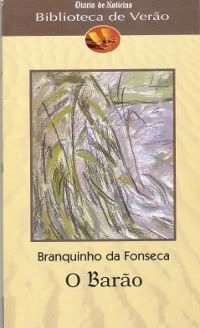
O Barão - Branquinho da Fonseca

First crap book of the year! Let's celebrate! Honestly, I went into this excited, because I had just finished O Mistério da Estrada de Sintra , so I was all like "yeah, let's read some more portuguese authors!" only to become puzzled, bored and frustrated. Despite the title, O Barão - or, at least, the version I have of it - includes 2 more stories, As Mãos Frias and O Involuntário. Let's start with O Barão. The back cover says:

Novelist and short story writer, Branquinho da Fonseca was one of the founders of "Presença", the famous magazine that helped modernize portuguese literature. [...] O Barão probably is Branquinho da Fonseca's most popular book. The author delves in the telluric Barroso hill, deep in the core of Portugal, where he battles with a primitive world that dominates and almost absorbs him. The baron is one of the most fascinating and overwhelming characters of all portuguese literature.

Now, believe me: that last line is complete bullshit. But I'll get to that soon. First of all, it does surprise me that this is the guy who, in some way, was a pioneer in our country. How? I mean, I do get that you have to consider the time this was written in, but the Eça de Queiróz book was, in 1870, a lot more modern than this one, written in 1942. Now that just boggles my mind. How can something written in the middle of a war - well, even though Portugal was sipping on tea waiting for it to end, trying to be as far away from trouble as possible - and sound so self-indulgent, futile and detached from reality? I love how they mention the "telluric" aspect of it, but in reality, the actual place they were in was mentioned quite briefly. It's less about how beautiful and magical the place was and more about how magical and beautiful women are, in general. I think I would have liked not hated it if the book didn't try to be anything else than an ode to the powerful passions stirred by even the simplest of women. I use "simple" because both main characters have huge boners for the lady who makes them dinner. Why? Because OOOH THE COUNTRY THE ROMANCE SHE HAS BREASTS AND I'M DRUNK, BUT NOTHING WILL HAPPEN. There, that's the whole story for ya. And the baron? Self-absorbed, alcoholic douchebag who coerces the school inspector who's staying with him to drink a whole lot even though he will work the next day. Also, he convinces him to run around at 3 am going to some woman's house, to do...something. Being drunk, mostly.

(I love how I have so much to say about a book I didn't like, and yet for Sourcery I only wrote a small paragraph)

What about the other two stories? Well, since you asked, I can tell you that they are equally pointless and unimpressive. All the characters create big philosophical manifestos out of nothing, only to arrive to absolutely no conclusion. Ineffectual, meaningless tripe.

I usually have a rule about stuff I don't like: however bad it was, I will still try to read another book by that author because I don't think you can honestly judge their work having read only a tiny morsel of it. That being said, you can be damn sure I won't be running to library in search of more Branquinho da Fonseca. I have wasted enough time already.


Excerpt:

Já estávamos ambos embriagados. O Barão ergueu-se, fitou-me e disse, de repente triste:
- Vamos beber por uma mulher.
Levantei-me também. Foi tão tal armário e trouxe uma garrafa de champanhe. Berrou:
- Taças!
E tentava tirar o arme da rolha, sem conseguir. Veio a criada e pôs quatro taças sobre a mesa. O arame não saía. Então bateu com o gargalo da garrafa na borda da mesa e o champanhe jorrou em espuma branca. Reparando que estavam mais taças, com as costas da mão atirou duas da mesa abaixo. Eram de reserva. Porém, daquela vez não queria reservas. E ergueu a taça que transbordava. Eu imitei-o, perguntando nebulosamente:
- A que mulher?
- À única!
E bebemos ao mesmo tempo, despejando-as de um só trago. MAs com surpresa notei que o barão tinha ficado subitamente pensativo. Depois, com um gesto solene atirou o copo ao chão e fitou-me, silencioso. Fiz o mesmo, atirei a taça.

Monday, 8 March 2010

Literary Cleanup, book #3


O Mistério da Estrada de Sintra – Eça de Queiróz*/Ramalho Ortigão

First off, note that I only scanned the cover of the book I read because I like to have the exact covers I had on these posts. Also, there's the collection of short stories I mentioned. Funnily enough, at 160 pages, this is the longest one. Onwards!


Eça de Queiróz is one of the most notable portuguese writers, if not the most popular novelist. Up until now, I had only read Os Maias, which is required at most high schools, and everybody will tell you what a pain it is to read Os Maias. Those people obviously have no concept of pain. Real pain is Viagens na Minha Terra, and I like Almeida Garrett, so there. The thing is, his writing is incredibly descriptive and sometimes one does feel as if there hasn't been any story for the last 20 pages, just endless accounts of furniture smelling like the first cherry blossoms and women also smelling like something pleasant (and erotic). It says on the tin on the preface that he and Ramalho Ortigão quite hate this book and only published it because they feel that no writer should hide even their most terrible work. Of course, upon reading this, I thought “how pleasant that you say you hate it, that it's below you, but you'll still welcome the money it will make”. Anyway, I really enjoyed this one. And perhaps that is so because it is quite different from his style (I can't speak for Ramalho Ortigão, though); you see, the whole book is comprised of letters that were sent to a newspaper, giving the idea that this story actually happened. And reading each letter, you are caught, enticed by this odd mystery and immediately want to read the next chapter (or letter, in this case). This is the mark of a good mystery/thriller. If it excites your mind, then the pacing is right and your story is indeed intriguing. I quite enjoyed seeing it unravel, little by little, even though I sort of guessed what happened after I read the third (or was it the 4th?) letter.
If you are not a big crime/mystery novel person, you should at least know that it is quite easy to read. It even made me want to change up my reading order so I could get to some more portuguese novelists instead of jumping right onto Neil Gaiman or something of the sort.
A friend of mine mentioned this has a movie, so if you're not willing to try the novel, at least consider the movie, since, as I understand, it has a interesting take on the events.


Excerpt:

Não obstante a disposição em que me achava de ceder da luta e de entrar no trem, perguntei em alemão ao meu amigo se ele era de opinião que resistíssemos ou que nos rendêssemos.
- Rendam-se, rendam-se para nos poupar algum tempo que nos é precioso! - disse gravemente um dos desconhecidos. - Por quem são, acompanhem-nos! Um dia saberão por que motivo lhes saímos ao caminho, mascarados. Damos-lhe a nossa palavra de que amanhã estarão nas suas casas, em Lisboa. Os cavalos ficarão em Sintra daqui a duas horas.
Depois de uma breve relutância, que eu contribuí para desvanecer, o meu companheiro apeou-se e entrou no cupé. Eu segui-o.

*I've always spelled his name that way.

Monday, 1 March 2010

Literary Cleanup, book #2


(now fixed, thanks Zé!)
 
Sourcery - Terry Pratchett

Third book in the Rincewind series, Sourcery is, so far, my favorite, story-wise. I really liked how the – already quite interesting – premise played out and I also enjoyed seeing more of the Librarian. Also, Conina and...I don't remember his name, but it was the young hero who was only a hero in theory, were quite fun, and I loved seeing their interaction with Rincewind. And I must add that the Seriph's pick up lines were amazing. I will never look at a melon again without thinking it should be jewelled. The book ends on a puzzling note, and I'm really looking forward to the next one, though I have promised myself I wouldn't buy Eric (the next in the series) until I read the rest of my list.

Excerpt:

Without hesitation, Rincewind took a step backwards.
'Over to you, friend,' he said.
'Right!'
Nijel drew his sword and held it out in front of him, his arms trembling at the effort. There were a few seconds of total silence as everyone waited to see what happened next. And then Nijel uttered the battle cry that Rincewind would never quite forget to the end of his life.
'Erm,' he said, 'excuse me...'

Thursday, 25 February 2010

Literary Cleanup, book #1

First off, I have to say that these were actually the 2nd and 3rd book I read this year, but because I had started The Gun Seller a long time ago and just now had the inclination to finish it, I will not count it for the list.

Book#1


The Light Fantastic - Terry Pratchett

While the image I used looks very nice and neat, my book has seen better days, because he spent almost all of last year in my backpack tumbling around, so it looks twenty years old. I am a bad person. Also, under the title, my book has "A Discworld Novel" instead of the text presented in the image above.

Did I like it? I'd be an ass not to.


Thursday, 18 February 2010

Literary Challenge, zee overview.

This will be a pain to write down, but here is a list of all the books I have. Note the following: borrowed books are in green, and entries marked with an * are the english version of that particular novel. The striked ones are obviously the ones I've already read (the ones with a link pointing to a blog post and with a note saying "read on LC" are the ones pertaining to this challenge). Also, titles will be on the right and authors on the left.


Sunday, 14 February 2010

50 books? Woah there, I barely know how to read.

(THIS UPDATE WAS MADE IN A TIMELY MANNER.)

So, ever since I found out about a community on livejournal called 50 book challenge , I've tried many times to, and this will surprise you, do the 50 book challenge. This was one of the attempts. Of course, as you can see, I didn't finish it. Not by a long shot-- even though, I have to say, I didn't read only 5 books. This is the full list of stuff I read pertaining to the challenge:

  • Native Tongue
  • The Canterville Ghost
  • The Smile at the Foot of the Ladder
  • Lord Arthur Saville's Crime
  • The Haunted House (and other stories)
  • The Thirteen Problems 
  • Homely Girl: A Life and Other Stories
  • Treasure Island
  • The Color of Magic
  • Lunário
  • Memoirs of a Geisha
  • Guards! Guards!

    Seeing this list makes me think that I haven't done that bad (particularly because I'm sure I have forgotten a couple of books) but 12 books in a year isn't something to be satisfied with. Particularly when I realize how much time I waste on youtube/tv shows/cheesy asian dramas. And this all stems from the fact that reading a book requires a bit more effort than standing in front of the pc while STUFF happens. So I'm picking this up again, just to see where I can go with it. Or how much I can fail at it.